Monday, November 27, 2006
Wow
What else can I say. =) It would be a miracle if I passed. Wow. In my defense, our test started about 5 hours later than the stated, published time. And for those who have been through that grueling experience, you know that such a time schedule would amplify the difficulty. If I do pass, I will have enormous bragging rights! But, believe you me, I did not pass.


Friday, November 17, 2006
Getting ready for the plunge
This will be my last post before I sit for the OCM. I have mixed feelings about it - the 9i OEM tools are littered with bugs and holes, and while the tool (if you can call it that) may be good for some specific scenarios, I have come to detest it. Especially the java interface, which is cheapened even more on the RedHat platform (some buttons are truncated or all-together missing). On the good side, I have gotten to know RMAN a whole lot better. Reading Robert Freeman's book (and running into him on oracle-l) has been good, and Oracle has improved RMAN so much since 8i that I am actually impressed. It took them a while, but they finally come out with something that is more helpful than painful.
Another thing that concerns me is that I am not a good test-taker. It helps tremendously that this particular Practicum will be scenario based - it will almost be like "normal work". Except no socializing, no music, no Google, and the snacks are .... well, it will sustain me at least. So, not quite like work, but the actual "doing it" will be.
I also look forward to networking. There will be 6 others taking the Practicum with me, and it will be interesting to hear about their backgrounds. And assuming I pass, I am excited about meeting the community of Masters out there. If I do not pass, I will just have to wait a bit longer. *grin*
Based on the public information available about the Practicum, and anticipating a NDA/gag-order, here is what I believe the test will be like (all of this is from memory):
There is a blurb in the Oracle documentation about the Practicum that says one should use so-called "best practices" and Oracle tools to speed things up, because you are on the clock. I feel pretty confident that I can do most things reasonably fast, but I do have doubts in the back of my head. I can setup a standby database using rman (and using the same technology, create a clone for replication or whatever else). I can use OEM for most of the basic tasks, but I worry about how fast that will actually be, as opposed to just using the command-line which I am more comfortable with. For instance, one of the bullet points for the exam prep is "Use OEM to modify a database configuration". You mean like "alter database set optimizer_index_caching = 80"? Do you realize how many button clicks that is? 8, with a wall clock time of 83 seconds (which obviously depends on how fast your computer is).
In closing, I also wonder how different the 10g OCM is. Could I take that now? I have been working with 10g for a little while now, and know my way around EM/Grid Control. In some respects, it is much better. One of the downsides is that the new EM is so comprehensive that one can easily get lost if you are in unfamiliar territory. See my previous posts about trying to manipulate the Maintenance Window. *grin* I am not going to switch my course of action now - sticking with 9i. But I do wonder... perhaps I can get a steep discount and take the 10g OCM in the near future.
And finally, I remind myself that there are many many smart people out there who have not even taken the OCM just because they do not see a good reason for it. If/when I am a fully certified Master, I still realize my low post on the totem pole. The folks on oracle-l, askTom, the oracle forums (and even the dwellers in metalink Forums) and a slew of other places, are extremely smart and I learn from them on a daily basis. I hope to be able to contribute something, but just because of some pretentious title does not mean that I know everything.
Another thing that concerns me is that I am not a good test-taker. It helps tremendously that this particular Practicum will be scenario based - it will almost be like "normal work". Except no socializing, no music, no Google, and the snacks are .... well, it will sustain me at least. So, not quite like work, but the actual "doing it" will be.
I also look forward to networking. There will be 6 others taking the Practicum with me, and it will be interesting to hear about their backgrounds. And assuming I pass, I am excited about meeting the community of Masters out there. If I do not pass, I will just have to wait a bit longer. *grin*
Based on the public information available about the Practicum, and anticipating a NDA/gag-order, here is what I believe the test will be like (all of this is from memory):
- Primary focus on "normal" activities
- install software (not sure how much of this we will have to do, since it takes time)
- setup environment
- setup OEM
- setup RMAN
- setup/configure database (different flavors, different purposes)
- setup network files
- backup/recovery
- "recover from any failure scenario" is rather intimidating
- Time is an important resource, so a cold backup every hour is not going to work
- tune performance
- manage database
- add/drop tablespaces, tables, objects
- adjust storage specs as needed
- Secondary focus on specific features
- shared/dedicated servers
- standby database
- partitioned tables
- data access
- security, including vpd/fgac
- auditing
- Tertiary focus on more advanced things that do not really work well (the GUI sucks!)
- Advanced Replication
- Resource Management
- Possibly Dataguard
There is a blurb in the Oracle documentation about the Practicum that says one should use so-called "best practices" and Oracle tools to speed things up, because you are on the clock. I feel pretty confident that I can do most things reasonably fast, but I do have doubts in the back of my head. I can setup a standby database using rman (and using the same technology, create a clone for replication or whatever else). I can use OEM for most of the basic tasks, but I worry about how fast that will actually be, as opposed to just using the command-line which I am more comfortable with. For instance, one of the bullet points for the exam prep is "Use OEM to modify a database configuration". You mean like "alter database set optimizer_index_caching = 80"? Do you realize how many button clicks that is? 8, with a wall clock time of 83 seconds (which obviously depends on how fast your computer is).
In closing, I also wonder how different the 10g OCM is. Could I take that now? I have been working with 10g for a little while now, and know my way around EM/Grid Control. In some respects, it is much better. One of the downsides is that the new EM is so comprehensive that one can easily get lost if you are in unfamiliar territory. See my previous posts about trying to manipulate the Maintenance Window. *grin* I am not going to switch my course of action now - sticking with 9i. But I do wonder... perhaps I can get a steep discount and take the 10g OCM in the near future.
And finally, I remind myself that there are many many smart people out there who have not even taken the OCM just because they do not see a good reason for it. If/when I am a fully certified Master, I still realize my low post on the totem pole. The folks on oracle-l, askTom, the oracle forums (and even the dwellers in metalink Forums) and a slew of other places, are extremely smart and I learn from them on a daily basis. I hope to be able to contribute something, but just because of some pretentious title does not mean that I know everything.
Friday, November 10, 2006
Buggy bugs
This past Sunday (05-NOV-2006) we installed patch 4752541 (Intermittent PLS-306 / ORA-1722 / ORA-1858 under load) to fix a problem our webapp was having on overloaded procedure calls. We were looking golden up until Wednesday when our Production system starting spiking on library cache latch waits (and log file sync waits were in there as well). Being good little Oracle DBAs, we filed a case with Oracle Support, and learned a bit, but nothing really concrete. That evening we hit another major slowdown. It was decided to yank out the Sunday patch because it did exhibit some relationship and we thought it best to be safe. So here we are, Friday, with no more critical slow downs but still hitting the original webapp errors. We now have 3 SRs open with Oracle, 4 engineers working on them, two "team leads"/duty managers keeping tabs, and a cell-phone number for the Director of Oracle Support.
All this to say that Oracle is really, very complex. We still do not even know for sure if the patch caused the slowdown, all we have is the circumstantial evidence. This also showcases why you get a 10gR2 patchset that is rife with bug fixes and has a footprint that is as large as a baseline install. 10.2.0.3 promises to be more of the same, meaning that 10.2.0.2 had little to no impact on the number of bugs. Granted, 10.2.0.2 did fix a large number of problems, but it looks like the sum of the ones that got through the cracks and newly introduced bugs (ala "Buggy bugs") totals the bugs fixed.
Just to set the record straight, I only complain and gripe about software I love.
All this to say that Oracle is really, very complex. We still do not even know for sure if the patch caused the slowdown, all we have is the circumstantial evidence. This also showcases why you get a 10gR2 patchset that is rife with bug fixes and has a footprint that is as large as a baseline install. 10.2.0.3 promises to be more of the same, meaning that 10.2.0.2 had little to no impact on the number of bugs. Granted, 10.2.0.2 did fix a large number of problems, but it looks like the sum of the ones that got through the cracks and newly introduced bugs (ala "Buggy bugs") totals the bugs fixed.
Just to set the record straight, I only complain and gripe about software I love.
Monday, October 30, 2006
Oracle has not yet learned the definition of "unbreakable"
Given:
oracle.com on October 30, 2006
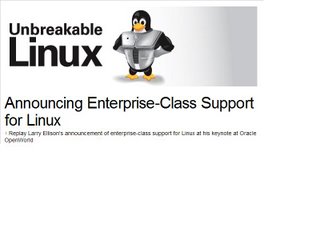
Given:
unbreakable
un·break·a·ble (n-brk-bl) Pronunciation Key Audio pronunciation of "unbreakable" [P]
adj.
1. Impossible to break; able to withstand rough usage: unbreakable plates.
2. Able to withstand an attempt to break. Used of a horse.
Given:
Metalink SR tool on Monday, October 30, 2006
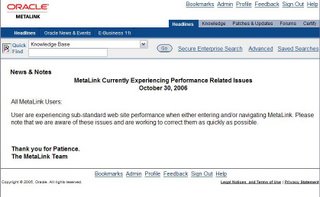
oracle.com on October 30, 2006

Given:
unbreakable
un·break·a·ble (n-brk-bl) Pronunciation Key Audio pronunciation of "unbreakable" [P]
adj.
1. Impossible to break; able to withstand rough usage: unbreakable plates.
2. Able to withstand an attempt to break. Used of a horse.
Given:
Metalink SR tool on Monday, October 30, 2006
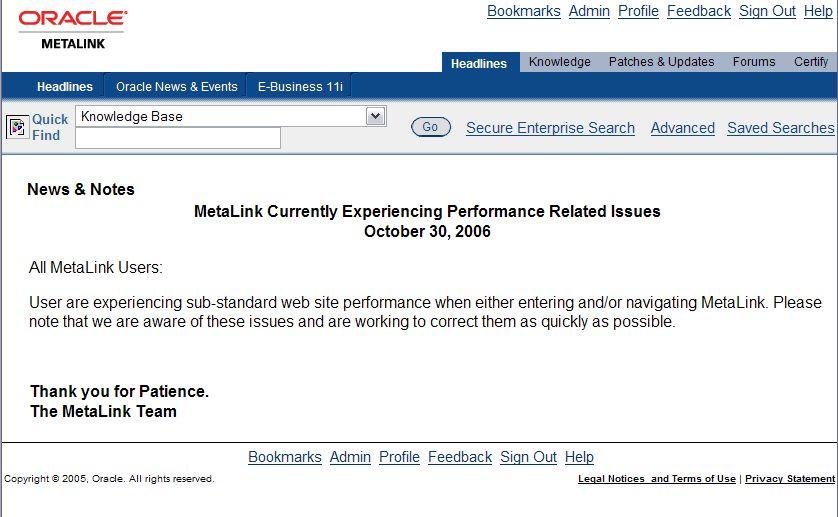
Thursday, October 26, 2006
Oracle announces Enterprise Support for Linux, for half the price
This is sad. This exemplifies the statement "You get what you pay for."
Much has been said, and much is still being said, about this poor decision, but my favorite so far is Dave Dargo's Bull*%$#!
Much has been said, and much is still being said, about this poor decision, but my favorite so far is Dave Dargo's Bull*%$#!
Wednesday, October 25, 2006
Support Analyst caught asking Tom
I found this very interesting.
http://asktom.oracle.com/pls/ask/f?p=4950:8:::::F4950_P8_DISPLAYID:707586567563
Search for "We have noticed several system tables where"
Keeping that in mind, here is my question in SR# 5684375.992 on 11-AUG-06:
Is it just me, or did my support analyst ask my question on AskTom, verbatim?
While I like Tom's cavalier attitude in general (ala "and you don't need/want to be querying hist_head$, just use the normal views like the rest of us :)"), I sure wish he answered the question.
Another interesting point: this question was posed on August 14th, the same day I got fed up with the Support Analyst and asked to switch to someone else. I liked the 2nd guy much better! You could give him awards. But that first guy… wow, he needs help.
As I said, just very interesting. I wonder how many other Support Analysts I can find on AskTom.
http://asktom.oracle.com/pls/ask/f?p=4950:8:::::F4950_P8_DISPLAYID:707586567563
Search for "We have noticed several system tables where"
Keeping that in mind, here is my question in SR# 5684375.992 on 11-AUG-06:
This SR is for information only. We have noticed several system tables where dba_tab_col_statistics reports HEIGHT BALANCED histograms where bucket_cnt > distcnt (count of distinct values). It was my understanding that a similar problem was fixed in 10.2.0.1 (dbms_stats method_opt size n generates a FREQUENCY histogram where n >= NDV). However, even more perplexing is why do we have many height balanced histogram buckets on a column with only 1 distinct value?
SQL > select ENDPOINT_NUMBER,ENDPOINT_VALUE
from dba_histograms
where table_name = 'INDPART$'
and column_name = 'TS#';

ENDPOINT_NUMBER ENDPOINT_VALUE
--------------- --------------
            217             79
So, some questions?
1. in sys.hist_head$, how is bucket_cnt calculated?
2. what determines how many buckets a column gets?
Is it just me, or did my support analyst ask my question on AskTom, verbatim?
While I like Tom's cavalier attitude in general (ala "and you don't need/want to be querying hist_head$, just use the normal views like the rest of us :)"), I sure wish he answered the question.
Another interesting point: this question was posed on August 14th, the same day I got fed up with the Support Analyst and asked to switch to someone else. I liked the 2nd guy much better! You could give him awards. But that first guy… wow, he needs help.
As I said, just very interesting. I wonder how many other Support Analysts I can find on AskTom.
Tuesday, October 24, 2006
OCM, histograms and more Oracle
I debated about how publicly I wanted to announce that I am taking the OCM. Seeing as how nobody reads this blog, if anyone ever finds out, it will be after the fact. My impression of the OCM is that it is rather tough to take, but is mostly a PR thing - Oracle gets an easy $2000, and in return, I get bragging rights with a denim shirt. Looks good for our HR department though. The thing is, there are a lot of really smart DBAs out there who could easily pass the OCM and simply have not the time or inclination to do so. I think there is also the stigma that someone who is a certified Master should not make any mistakes and knows everything. *laugh* Don't expect that from me.
So, on to histograms. I am still beleaguered by how best to describe the data. I have tossed the idea of unlimited histogram buckets to Oracle, but the rub I get back is that the overhead is not worth it. Overhead = physical storage + cost of getting bucket information. I will be the first to admit that my number theory is not the strongest - in fact, I am one of the worst kinds of methodical scientists because I am not, well, methodical. I just want to try out a 10-million bucket histogram and see if it actually is worth it for myself. In talking to Wolfgang Breitling, I see there are other ramifications to consider as well, like join cardinalities. Call me naive, but it seems that if you have 100% accurate histograms (no matter how large/how many), your join cardinalities will be 100% accurate as well. That is the problem with a little bit of knowledge - there is so much more you do not know, but you do not necessarily know it. *grin*
More Oracle: Actually, I should say, more SCT. We do a lot of work with SCT (now called SunGard Higher Education, or SHE) BANNER, an ERP from California. As with any monstrous ERP, there are a number of issues, but probably the worst is that they were the lowest bidder, and we are their largest customer. Do the math. Good for them, bad for us. And we who do the performance diagnostics and troubleshooting affirm that every day. Again, going back to Wolfgang, I wish there was an outside expert/consultant in the realm of Oracle/BANNER, a real Application DBA. At this point in my career, I am saying to myself "That's what I want to be when I grow up." Maybe not necessarily for SCT/SHE (and they sorely need them!), but .... maybe.
Another dream I have is to get inside the guts of the Oracle kernel. This is hard to do when
So if you know of any rogue Oracle developers that teach Internal classes, let me know. *grin*
So, on to histograms. I am still beleaguered by how best to describe the data. I have tossed the idea of unlimited histogram buckets to Oracle, but the rub I get back is that the overhead is not worth it. Overhead = physical storage + cost of getting bucket information. I will be the first to admit that my number theory is not the strongest - in fact, I am one of the worst kinds of methodical scientists because I am not, well, methodical. I just want to try out a 10-million bucket histogram and see if it actually is worth it for myself. In talking to Wolfgang Breitling, I see there are other ramifications to consider as well, like join cardinalities. Call me naive, but it seems that if you have 100% accurate histograms (no matter how large/how many), your join cardinalities will be 100% accurate as well. That is the problem with a little bit of knowledge - there is so much more you do not know, but you do not necessarily know it. *grin*
More Oracle: Actually, I should say, more SCT. We do a lot of work with SCT (now called SunGard Higher Education, or SHE) BANNER, an ERP from California. As with any monstrous ERP, there are a number of issues, but probably the worst is that they were the lowest bidder, and we are their largest customer. Do the math. Good for them, bad for us. And we who do the performance diagnostics and troubleshooting affirm that every day. Again, going back to Wolfgang, I wish there was an outside expert/consultant in the realm of Oracle/BANNER, a real Application DBA. At this point in my career, I am saying to myself "That's what I want to be when I grow up." Maybe not necessarily for SCT/SHE (and they sorely need them!), but .... maybe.
Another dream I have is to get inside the guts of the Oracle kernel. This is hard to do when
- you don't work for Oracle
- you despise the scientific method
- you play a lot of video games
So if you know of any rogue Oracle developers that teach Internal classes, let me know. *grin*
Subscribe to:
Posts (Atom)
